
One of the most confusing things about Avoidant/Restrictive Food Intake Disorder (ARFID) is that the same condition can look completely different from one person to the next.
One child may avoid foods because certain textures, smells, or consistencies feel unbearable. Another may eat a decent variety but has such little interest in food that getting enough feels like a lot of work. And kiddo #3 may start restricting after a scary choking or vomiting experience and become fearful around eating.
All three can be ARFID.
When people talk about the types of ARFID, they’re usually referring to three main ways it shows up: sensory sensitivity, low interest in food or eating, and fear of something bad happening when eating. Each “flavor” of ARFID can range from relatively mild to significantly disruptive.
ARFID is something I care about explaining well: it is genuinely complex. If you’re new here, I’m Marissa Beck, MS, RDN, a Registered Dietitian Nutritionist and founder of REVV Health. Since 2009, I’ve worked with children, adolescents, and adults whose eating habits and challenges don’t always fit neatly into a box, including ARFID, restrictive eating, disordered eating, and feeding concerns. A big part of my job is figuring out what is actually making eating so hard for each particular patient, because that guides our approach to nutrition support.
By the end of this article, you’ll understand the three main types of ARFID presentations, what each can look like in real life, how they can overlap, and why knowing what is driving the restriction can help guide treatment.
If you’re still trying to understand how ARFID develops in the first place, start with What Causes ARFID? It Wasn’t Your Fault. In that post, I focus on what we know about how ARFID develops and why there usually isn’t one simple cause.
First, what actually makes it ARFID?
It’s not just the symptom; it’s the impact and what is driving it.
Think about a fever. A temperature of 102°F tells us something is going on, but it doesn’t tell us why. We still need to figure out what is causing the fever because that determines what we do next.
ARFID is similar. Knowing that someone is restricting food is important, but understanding why eating is hard and how much that restriction is affecting their life is what helps guide the right support.
Before we get into the different types of ARFID, a quick reminder: ARFID is an eating disorder, but unlike anorexia nervosa or bulimia nervosa, ARFID restriction is not driven by concerns about body weight or shape. With ARFID, the restriction is impacting nutrient intake, growth, health, or daily life.
ARFID involves avoiding or restricting food enough that it has a meaningful impact in at least one of these areas:
- growth or weight, such as weight loss, difficulty gaining expected weight, or slowed growth in a child
- nutrition, including significant vitamin or mineral deficiencies
- reliance on supplemental nutrition, such as oral nutrition supplements or tube feeding
- daily life, where eating difficulties significantly interfere with things like school, work, relationships, travel, family meals, or social events
That last bullet point is especially nuanced because someone can be growing quite well, have no obvious nutritional deficiencies, and still have ARFID. If the restriction makes birthday parties, school lunch, sleepovers, restaurants, travel, or eating with other people incredibly difficult, that psychosocial impact may still meet ARFID criteria.
ARFID also isn’t diagnosed simply because someone eats differently from the people around them. The restriction can’t be better explained by food being unavailable or by a cultural or religious eating practice. This means eating differently is not, by itself, a disorder. The eating pattern has to be causing meaningful nutritional, growth, medical, or day-to-day problems that go beyond culture, access, or personal preference.
You cannot self-diagnose. ARFID is complex and needs to be diagnosed by a qualified healthcare professional who can look at the whole picture. A proper diagnosis includes being able to rule out other reasons someone may be restricting food.
With a diagnosis of ARFID, the next question is: what is making eating so hard?
There are three main reasons for ARFID.
- Sensory sensitivity
- Lack of interest in food or eating
- Fear of something bad happening when eating
You’ll often hear these called the three “types” of ARFID, but technically they’re better thought of as presentations or “drivers of the restriction.” They are not three completely separate diagnoses, and they definitely don’t stay in their own lanes. Someone can experience one, two, or all three at the same time. In other words, these are overlapping, not rigid categories (1).
Let’s explore these three different subtypes – it is pretty amazing that the same diagnosis can present so differently in people, based on what is fueling the restriction for them as an individual.
1. Sensory-sensitive ARFID
For some people with ARFID, the main driver is sensory sensitivity.
Certain textures, smells, tastes, temperatures, appearances, or consistencies can feel intensely unpleasant or hard to tolerate. This can make eating feel overwhelming in a way that goes far beyond simply “not liking” a food.
You might see things like:
- sticking to a very small number of predictable foods
- eating only specific brands
- avoiding mixed textures
- noticing tiny changes in taste or consistency that other people barely register
- refusing foods that are too soft, too crunchy, too chewy, too wet, or too unfamiliar
- tolerating a food prepared one way but not another
- avoiding restaurant foods because they feel too unpredictable
To be clear, sensory sensitivity by itself does not automatically mean ARFID. Plenty of people have strong food preferences or sensory quirks and don’t qualify for a diagnosis of ARFID. ARFID enters the picture when the restriction becomes significant enough to affect nutrition, growth, reliance on supplements, or daily life.
For example, a child might strongly dislike mushy foods but still eat enough variety across other textures to meet their needs and participate comfortably in meals. That is very different from a child whose texture sensitivity limits them to a handful of predictable foods, makes eating away from home extremely difficult, or prevents them from getting enough nutrition.
For someone with sensory-sensitive ARFID, treatment is usually around keeping nutrition adequate while gradually building more comfort, familiarity, and flexibility around food.
2. Lack of interest in food or eating
For some people with ARFID, the main issue is not fear or sensory sensitivity. It is simply that food does not feel very motivating.
They may have a low appetite, get full quickly, forget to eat, or rarely feel strong hunger cues. Eating can feel like work, an annoying interruption, or something they have to remind themselves to do rather than something their body naturally prompts them toward.
You might see things like:
- rarely saying they are hungry
- needing reminders to eat
- eating very slowly
- getting full after only a small amount
- skipping meals without really noticing
- struggling to finish enough food before feeling done
- describing eating as boring, annoying, or like a chore
- being able to go a long time without asking for food
This presentation is often called lack of interest in food or eating, and research describes it as being driven by low appetite, low interest, early fullness, or weak hunger cues (2).
This is where the advice, “They’ll just eat when they’re hungry,” can really miss the mark.
For someone with low-interest ARFID, hunger may not show up strongly enough to reliably drive enough intake. So waiting for hunger to do all the work can mean they simply eat far too little overall.
This presentation can also overlap with the others. Someone may have low appetite and sensory sensitivity, or low interest in food may develop alongside fear after a difficult eating experience.
As with the sensory presentation, low appetite on its own does not automatically mean ARFID. The concern here is whether the restriction is significant enough to affect nutrition, growth, reliance on supplements, or daily life.
For someone with low-interest ARFID, treatment often focuses first on making eating more consistent and adequate, sometimes using structure and routine, like mechanical eating, rather than relying entirely on hunger cues.
3. Fear of something bad happening when eating
For some people with ARFID, eating feels unsafe.
Clinically, this is often called fear of aversive consequences, but in plain English it means exactly what it sounds like: they are afraid something bad will happen when they eat.
You might see things like:
- avoiding foods after a choking or vomiting episode
- cutting out foods that feel “too risky”
- taking very small bites or chewing excessively
- needing a lot of reassurance before eating
- avoiding restaurants, school meals, or social events because the food feels unpredictable
- becoming fearful of swallowing
- avoiding eating when they feel nauseated or worried about stomach pain
- gradually narrowing the range of foods they feel safe eating
Sometimes there is a clear starting point. A child chokes, gets a stomach bug, or experiences an allergic reaction, and eating suddenly feels much more threatening.
Other times, there is no single obvious event.
Fear can also spread. Someone may start out afraid of one food or one situation, then begin avoiding foods that seem similar, and eventually restrict much more broadly.
Research describes this presentation as restriction driven by fear of negative outcomes from eating, including choking, vomiting, pain, GI symptoms, and allergic reactions (3).
This is where a thorough medical evaluation is highly recommended. If someone is reporting pain, swallowing difficulty, reflux, nausea, or other physical symptoms, we do not want to assume it is “just anxiety.” Sometimes there is a real medical issue happening alongside the ARFID.
For example, a child with reflux or eosinophilic esophagitis may genuinely experience pain or difficulty swallowing, and that physical experience can then fuel fear and avoidance around eating. In that case, both the medical issue and the ARFID need attention.
For someone with fear-based ARFID, treatment often focuses on understanding what the person is afraid of, making sure relevant medical concerns have been evaluated, and gradually helping them feel safer and more confident around eating.
Can you have more than one type of ARFID?
Absolutely.
The three ARFID presentations are not separate boxes. Someone can experience sensory sensitivity, low interest in eating, and fear around food at the same time, and the mix can look different from person to person.
For example, I worked with a pediatric client who had been sensitive to textures since he was very young and relied on a fairly predictable group of foods. Then he had a scary choking experience, and suddenly some foods that had previously felt safe didn’t feel so safe anymore.
As his dietitian, my job was not to push variety for variety’s sake. We first focused on protecting adequate nutrition with the foods he could still manage, reducing pressure around meals, and slowly rebuilding confidence with foods that had started to feel unsafe. Over time, that gave us a more stable foundation to work from and helped him begin expanding what felt possible again.
An adult client of mine has very little interest in food, which already makes eating enough difficult. She also has food allergies and sensory sensitivities, leaving her with even fewer foods that feel “worth the effort” of eating.
For her, our nutrition work didn’t start with trying to expand the food list. We first focused on helping her eat enough with the foods that already worked. This helped because more consistent intake helped stabilize her energy, reduced the physical stress that comes with going too long without eating, and gave her more capacity to think about food without feeling completely depleted.
When your brain and body are underfed, everything can feel harder: decision-making, flexibility, appetite cues, anxiety, even the willingness to try something unfamiliar.
Once her body was getting more consistently nourished, we had a much better foundation to gradually work on flexibility and variety.
This overlap is one reason researchers describe the three ARFID presentations as dimensional rather than rigid categories. In other words, someone can experience a little of one, a lot of another, or meaningful features of all three. Research has also found that overlapping presentations are common in people with ARFID (4).
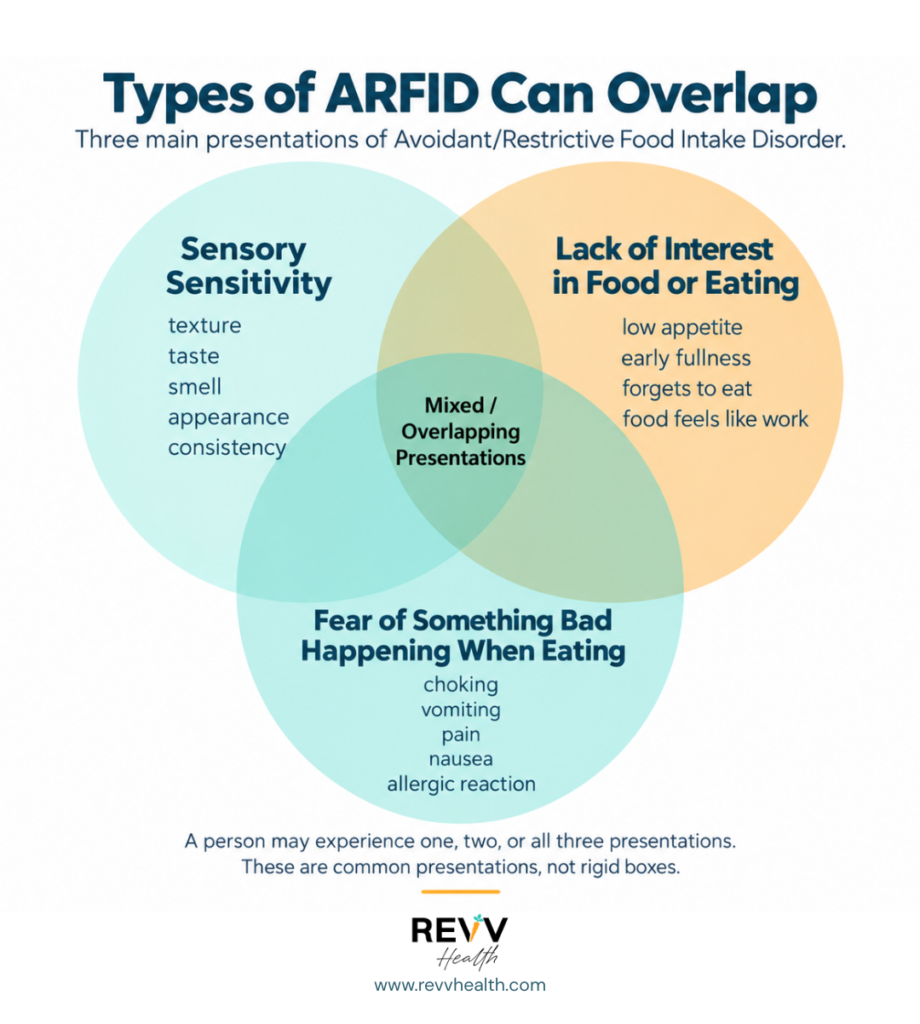
This is what the overlapping circles in the graphic above are meant to show. The circles aren’t three boxes you have to choose between. They represent three different things that can be making eating hard, with plenty of room for overlap in the middle.
That is also why figuring out someone’s “type of ARFID” really helps us understand what is driving the restriction and what we may need to address first.
Treatment for types of ARFID
Treatment for ARFID is not one-size-fits-all. It can look very different from one person to the next.
- Sensory-sensitive ARFID: A child may be eating enough overall but relying on a very small group of predictable foods with similar textures. Treatment may focus on protecting nutritional adequacy while gradually building familiarity and flexibility with foods that feel close enough to what is already safe.
- Low-interest ARFID: An adult may have very little appetite, forget meals, and get full quickly. Here, the priority may be less about expanding variety right away and more about creating structure, using convenient and energy-dense foods, and making sure intake is consistent enough to meet nutrition needs.
- Fear-based ARFID: A child may stop eating many foods after a choking or vomiting experience. Treatment may start with understanding what feels unsafe, making sure any medical or swallowing concerns have been evaluated, and gradually rebuilding confidence around eating.
- Mixed presentation: Someone may have sensory sensitivities, low appetite, and fear layered together. In that case, treatment may need to happen in stages. We may first work on getting enough nutrition in consistently, then address fear or avoidance, and later build more flexibility and variety.
Two people can have the same diagnosis and need very different kinds of support, which is why knowing the types of ARFID can be very helpful in seeking appropriate treatment.
Is this ARFID or picky eating?
This is where things can get confusing, because sensory sensitivity, low appetite, or fear around certain foods do not automatically mean someone has ARFID.
Plenty of people are picky eaters. Plenty of people have strong texture preferences. Some people naturally have lower appetites. Others avoid a food after one bad experience and eventually move past it.
What separates ARFID is the impact of the restriction.
With ARFID, the eating pattern has become significant enough to affect things like nutrition, growth, reliance on supplements, or everyday life.
For example, a child can be growing well and still have ARFID if eating has become so limited or stressful that birthday parties, school lunch, restaurants, travel, sleepovers, or family meals become genuinely hard to navigate.
Or, an adult can be meeting basic nutrition needs but still organize their entire day, social life, or travel around access to a very small number of foods they feel able to eat.
There is also no magic number of accepted foods that suddenly turns picky eating into ARFID.
The better questions are:
- Is the food list getting smaller?
- Is eating becoming more stressful or rigid?
- Is the person avoiding situations because of food?
- Is nutrition becoming harder to meet?
- Is the eating pattern interfering with daily life?
Those questions tell us much more than simply asking whether someone is “picky.”
To read about the difference in more depth, head over to my future article entitled ARFID vs. Picky Eating: How to Tell When Selective Eating May Be Something More.
The bottom line on the types of ARFID
ARFID is one diagnosis, but it can show up in very different ways.
You learned about the three main presentations:
- sensory sensitivity, where textures, smells, tastes, temperatures, or other sensory features make food hard to tolerate
- lack of interest in food or eating, where low appetite, early fullness, or very little motivation to eat makes it hard to get enough in
- fear of something bad happening when eating, such as choking, vomiting, pain, nausea, or an allergic reaction
And importantly, people do not always fit neatly into just one. Someone may have features of two or even all three presentations, and the mix can shift over time. That is one reason ARFID can look so different from person to person.
The main thing I want you to take away from this article is: understanding what is driving the restriction helps you understand why eating is hard, and that is what should guide treatment.
Last but not least, one symptom cannot tell you whether someone has ARFID. Sensory sensitivity, low appetite, or fear around food can exist without meeting criteria for this eating disorder. The impact on nutrition, growth, health, supplement reliance, and daily life is what helps determine whether ARFID is truly present.
Looking for support with ARFID?
If you or your child is struggling with restrictive eating, figuring out the “type” is only one piece of the puzzle.
At REVV Health, I work with children, adolescents, and adults with ARFID, restrictive eating, and feeding concerns. Nutrition care looks at what is driving the restriction, whether nutrition needs are being met, how eating is affecting daily life, and what kind of support makes sense from there.
Our goal is to understand what is making eating hard and build treatment to make things easier.
Learn more about ARFID nutrition counseling at REVV Health.

0 Comments